Walking through a city park is a pleasant way to escape the congestion of a metropolitan area. New York is famous for Central Park and its zoo. Chicago’s city planners had the foresight to keep miles and miles of Lake Michigan shoreline dedicated to open space and parks. Long before American city planners created beautiful parks for the public, London’s leaders designed many beautiful parks for the royalty.
Most notable is Hyde Park (350 acres) and a subsection, Kensington Gardens (270 acres). At the end of the 17th century, Kensington Gardens became a separate entity when King William and Queen Mary decided to take up residency at Kensington Palace. The Serpentine (a man-made lake) and Long Lake (a narrower lake on the western edge) became the dividing line between the two parks.
It is possible to tour part of the Kensington Palace. A future blog will highlight that piece of royal history.
Albert Memorial is just a short walk from the palace. Queen Victoria commissioned this massive monument in memory of her husband, Albert. He was stricken with typhoid when he was 42. Some authorities state that Prince Albert made his wishes known that he did not want a monument built in his memory. If this is indeed the case, his wife did not listen. Instead, she went overboard in creating a monument that few will forget. Was that true love or was she exhibiting ostentatious behavior?
We stumbled upon this memorial when we were trying to find the Holocaust Gardens. Along the way, we asked several park employees to point us in the right direction. None knew the whereabouts of the Holocaust Gardens. Without assistance, it was impossible to find.
After the storm passed, we were able to take several pictures of the opulent memorial.
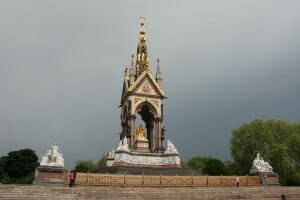
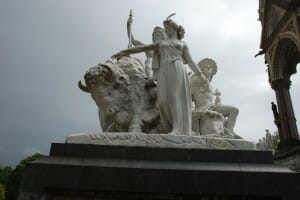
Set upon a pedestal of steps, the monument itself towers 176 feet. In the four corners are statues that represent Africa, Asia, America, and Europe. CU Buff fans can take pleasure seeing a buffalo as part of the American motif.
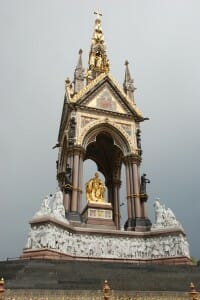
Under the canopy is an oversized golden statue of Prince Albert sitting on a chair. Intricate carvings of musicians, architects, poets, painters, and sculptors form the base of the statue.
Soon the rains continued. As we walked through the park, we admired the fragrant flowers and lush landscape.
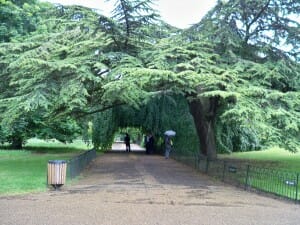
We never reached the Serpentine. Instead, we headed for shelter and admired the rich follage.
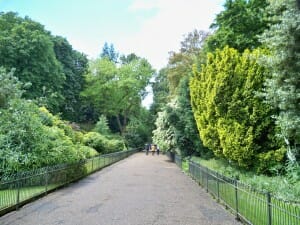
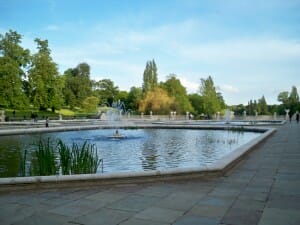
Later, we strolled along the northern edge of the park that runs adjacent to Bayswater Road. Right before we left Kensington Gardens and entered Hyde Park, we stopped to take pictures of the Italian Garden.
If it had not rained so much during our trip to London, we would have explored more.
Related Posts
Exploring Ancient Civilizations at the British Museum, London
Ancient Spiritual Luxury—The Roman Baths in Bath, England
Pump Room and Jamie’s in Bath England
Churchill War Rooms- An Abundance of History
A Foodies Paradise- London’s Borough Market
Sandra’s Bio
Sandra Bornstein is the author of MAY THIS BE THE BEST YEAR OF YOUR LIFE. It is available on Amazon. Sandra’s memoir highlights her living and teaching adventure in Bangalore, India. She is a licensed Colorado teacher who has taught K-12 students in the United States and abroad as well as college level courses. Sandra is married and has four adult sons.
The memoir was a finalist in the Travel category for the 2013 Next Generation Indie Book Awards, the 2013 International Book Awards, the 2013 National Indie Book Excellence Awards, the 2013 USA Best Book Awards, and received an Honorable Mention award in the Multicultural Non-Fiction category for the 2013 Global ebook Awards.
If you’re interested in travel, follow Sandra’s latest adventures on Examiner.com.


Leave a Reply
You must be logged in to post a comment.